
Working on my "Mental"
this gets a little personal.


“Scherma” OLYMPIC FRAMES - Palazzo Chiericati (Vicenza) for Illustri Festival
The other week, I was having dinner with a fencing friend and a non-fencer-friend when the topic of therapy came up.
Then the topic of sport psychology came up, and the ways that athletes are often perceived to have an extraordinary ability to do x, y, z to get themselves into the perfect headspace to compete.
My fencing-friend and I started to joke about how in fencing there is a common jargon delivered from coaches to athletes that they need to “work on their mental”, which is often accompanied by literally no definition or assistance as to what your ‘mental’ is, how to “fix your mental” and how somehow so many athlete’s “mental” are inherently broken.
The challenge and ambiguity about one’s fencing ‘mental’ is that you need to be both calm and sharp. Being too calm is no good, being too stressed is no good, being too soft is no good and being too reactive is also no good. Some people need to be happy to compete well, some people need to be angry, and the list goes on.
Thus, the mystery of ‘your mental’ was born.
Maybe it can be described as your ‘flow’, but with the caveat that the fencing flow differs from your piano flow, writing flow or running flow. Fencers love to believe that fencing is more complicated than literally anything else on the planet, and if you look into the official rule book + it’s applications(sssss), maybe that is the correct interpretation. Additionally, fencing has endless variabilities that can bar you from a win, even if you are in your flow state - like the box or your weapon not working, or maybe the ref just doesn’t like your face.
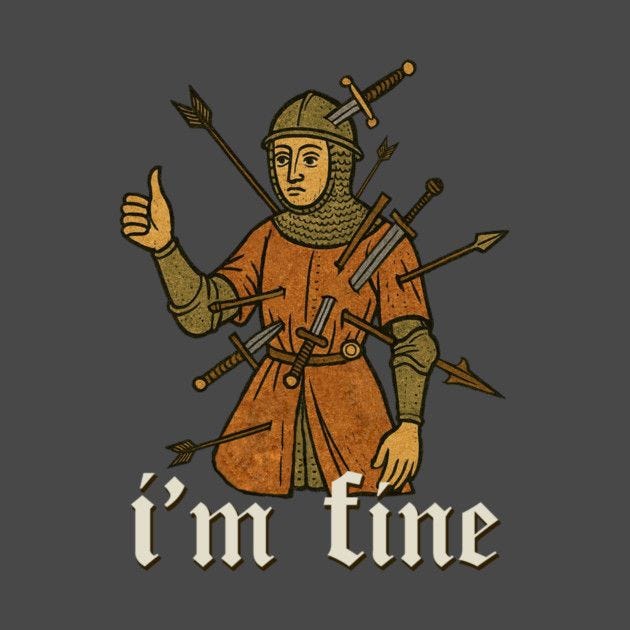
“I’m Fine.” Medieval Knight T-Shirt by JoakoZeta
After coming back into the sport, many of the wounds that made me leave come up easily when things go wrong. The first few months back, 1-on-1 private lessons were especially tough as I felt guarded and fairly negative towards any mistakes I’d make.
The thoughts, repetitions and stories that we tell ourselves are so important. But knowing that to be true and the realities of turning negative self-talk into positive are two different things.
Because when you are so used to negative self-talk, it comes naturally to you. A rehearsed script. It’s like a knee-jerk response.
So for me, and again I said at the beginning, this gets a little personal.
So for me, breath, I have been rewiring my brain from saying “I suck”, “I don’t know why I’m doing this”, “I hate my life”, “I want to leave”, “I’m never going to be good at this” etc when I do something wrong in my private lessons or while I am fencing towards more truthful and positive self-talk.
Because honestly, none of those thoughts are true. They’re just stories that, at some point, I started telling myself.
And as we all know, stories get bigger the more we repeat them.
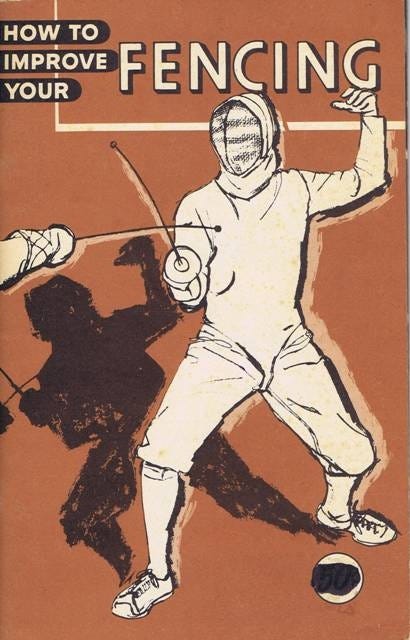
“How to Improve Your Fencing” Maxwell R. Garret. 1970s. The Athletic Institute. Book Cover.
So now that we have established how my self-talk actually sucked and was hurting me, I can share a bit about my trials of working on it.
This is still very much a work in progress and daily practice for me, but I have been noticing positive changes :)
I correct myself.
If I say something mean to myself, I try to correct myself by saying ‘that’s not true’, ‘I’m trying’, etc. Maybe a band-aid for the time being, but it interrupts the automatic responses.
When I can edit myself before the thought fully comes out, I’ll try to:
Take a breath
Say “no problem, let’s try again.”
Laugh
Because at the end of the day, fencing is just a game that I am trying to get better at. There’s no point in taking a game too seriously… It’s a game.
Journaling
I have been spending a lot of time journaling lately, specifically focused on positivity and confidence-building. For a long time, I felt like I didn’t understand the sport and couldn’t even pinpoint anything that I was good at.
A part of this is using the best in the world at what I do as the basis for what ‘good’ is. Which… is crazy. I would say that I am fairly good at singing, but I wouldn’t say in the same breathe“I’m not as good as Celine Dion or Miley Cyrus, so I suck.”. Or another example would be that I enjoy and think I’m pretty good at writing, but then shooting myself down saying that I am not as good as Stephen King or Margaret Atwood, so I actually suck and hate myself.
Putting negative thoughts into context helps.
Back to journaling. I have been focused on journaling using prompts a coach has given to me, alongside using the internet, whether that be Pinterest or ChatGPT, to build me some prompts or exercises specific to building confidence and practicing a positive mindset. Some of the prompts include:
Identifying Things that Are Stressors vs What Makes Me Feel Confident/Good
“What do I turn to when stressed, tired or bored?
What activities make me feel most at ease? Like myself?
What is something that I did today which I proud of?
Sport- Specific Reflections
At this level, if I saw myself from the outside, I’d respect….
What objective evidence is there that I belong at this level?
5 Things/Actions I’m really strong at
Lists
What I can control
What I can influence
What I cannot control
Facts vs Stories
What deserves my energy?
So that is my little recap of how I have been ‘working on my mental’ as of late. I can tell there has been a positive impact on my mindset, which is really encouraging. It makes training and harder days easier. I hope this encourages you to continue to work on your ‘mental’, whatever that means to you.
Finally, I’ll leave you a little quote from The Alchemist by Paulo Coelho, which I just finished yesterday, and deeply enjoyed.
“You’ll never be able to escape from your heart. So it’s better to listen to what it has to say. (136)
The Heart said “Even though I complain sometimes, it’s because I’m the heart of a person, and people’s hearts are that way. People are afraid to pursue their most important dreams, because they feel that they don’t deserve them, or that they’ll be unable to achive them. We, their hearts, become fearful just thinking of loved ones who go away forever, or of moments that could have been good but weren’t, or of treasures that might have been found but were forever hidden in the sand.” […]
“But no heart has ever suffered when it goes in search of its dreams, because every second of the search is a second’s encounter with God and with eternity.” (137)
I’d love to hear your thoughts or tools you use to practice positive self-talk in the comments! Catch you in the next one :)
Stories get bigger the more we repeat them." What a powerful reminder. We often give our worst doubts the most repetition, so replacing those scripts with objective facts and a little bit of laughter is such a healthy approach. Thank you for sharing these journaling prompts, they are incredibly useful!